| 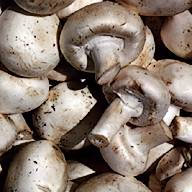 mushroom (Old English muscheron, from the Old French mouscheron, French mousseron (same name in English, for a common kind of mushroom), itself perhaps from mousse, meaning moss) is an above-ground fruiting body (that is, a spore-producing structure) of a fungus, having a shaft and a cap; and by extension, the entire fungus producing the fruiting body of such appearance, the former consisting of a network (called the mycelium) of filaments or hyphae. In a much broader sense, mushroom is applied to any visible fungus, or especially the fruiting body of any fungus, with the mycelium usually being hidden under bark, ground, rotted wood, leaves, etc. The technical term for the spore-producing structure of "true" mushrooms is the basidiocarp. The term "toadstool" is used typically to designate a basidiocarp that is poisonous to eat. Types of mushrooms
The main types of mushrooms are agarics (including the button mushroom, the most common mushroom eaten in the U.S.), boletes, chanterelles, tooth fungi, polypores, puffballs, jelly fungi, coral fungi, bracket fungi, stinkhorns, and cup fungi. Mushrooms and other fungi are studied by mycologists. The "true" mushrooms are classified as Basidiomycota (also known as "club fungi"). A few mushrooms are classified by mycologists as Ascomycota (the "cup fungi"), the morel and truffle being good examples. Thus, the term mushroom is more one of common application to macroscopic fungal fruiting bodies than one having precise taxonomic meaning. |