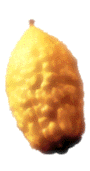
 The etrog, esrog, citron; Citrus fruit of a tree of the orange and lemon family. It is oblong in shape, and sometimes as much as six inches in length. The skin is thick, somewhat hard, fragrant, and covered with protuberances; the pulp is white and subacid. Modern naturalists assume the north of India to be its native home; but it passed to the countries of the Mediterranean from Media or Persia ; hence the name of the tree, "Citrus medica," and of the fruit, "Malum medica," or "Malum Persica".
It is therefore possible that the Jews brought the tree with them from Babylonia to Eretz Yisrael on their return from the Babylonian Captivity. Also See: Sukkot - Etrog Recipes For Sukkot A superior Esrog is of medium size, its bright yellow surface is furrowed and covered with Blitos, bumps (a feature which distinguishes it from the ordinary lemon). A Kosher Esrog for Sukkot:
- Consult your Rabbi about questions.
- Esrog must be shaped "like a tower"--its bottom larger than its top.
- Pitom, the flowered blossom at the tip of the fruit, and Uketz, the stem which is sunk into the broad base, must be examined carefully to make sure that both are present and intact.
- If the Pitom falls off or is broken during Sukkot, a rabbi should be consulted. To avoid this problem, many people prefer to use Esrogim which grow without Pitoms.
- The Pitom should be directly in line above the Uketz
Uses for Etrog after Sukkot - Cooking in cakes and jellies. Some people stick cloves into their etrog and use it as the fragrance spice at havdallah. Bartenura Etrog Citron Liqueur Delicate, sweet, silky-smooth with a honeyed perfume taste. Etrog comes from the ancient orchards of south Italy. Serve this unique liqueur straight up or over ice. |