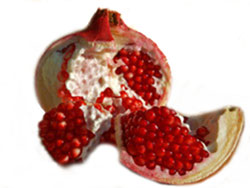
 The Pomegranate, Punica granatum, is a species of fruit-bearing deciduous shrub or small tree growing to 5-8 m tall. The pomegranate is believed to have originated in the area from eastern Iran to northern India, but its true native range is not accurately known because of its extensive cultivation. Jewish Recipe: Fruits
Pomegranate Chicken Breasts
Poached Fish with Pomegranate Sauce Recipes: Pomegranates Recipes The fruit is typically in season from September to November. The leaves are opposite or sub-opposite, glossy, narrow oblong, entire, 3-7 cm long and 2 cm broad. The flowers are bright red, 3 cm diameter, with five petals (often more on cultivated plants). The fruit is between an orange and a grapefruit in size, 7-12 cm diameter with a rounded hexagonal shape, has a thick reddish skin and many seeds. The edible parts are the seeds and the brilliant red seed pulp surrounding them. Although previously treated in its own family Punicaceae, recent genetic research by the Angiosperm Phylogeny Group shows that it is a member of the family Lythraceae. The only other species in the genus, Socotra Pomegranate Punica protopunica, is endemic on the island of Socotra. It differs in having pink (not red) flowers and smaller, less sweet fruit. Pomegranates are drought tolerant, and can be grown in dry areas with either a Mediterranean winter rainfall climate or in summer rainfall climates. In wetter areas, they are prone to root decay from fungal diseases. They are tolerant of moderate frost, down to about -10°C. |