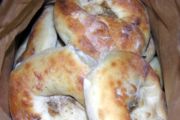
Bialy, a Yiddish word short for bialystoker, from Białystok, a city in Poland, is a small roll that is a traditional dish in polish Ashkenazi cuisine. A traditional bialy has a diameter of up to 15 cm (6 inches) and is a chewy yeast roll similar to a bagel. Unlike a bagel, which is boiled before baking, a bialy is simply baked, and instead of a hole in the middle it has a depression. Before baking, this depression is filled with diced onions and other ingredients, including (depending on the recipe) garlic, poppy seeds, or bread crumbs.
The name bialy is short for bialystoker kuchen (Bialystok's Cake). The bialy is little known outside of New York City, where it was originally brought into the United States by Ashkenazi Jewish immigrants during the late 19th and early 20th centuries.
The bialy was first marketed in the United States during the early 1900s in the state of New York by Harry Cohen, a proprietor of a bagel (and later bialy) establishment. Now, there is a single bialy bakery in Manhattan, Kossar's Bialys, founded by Morris Kossar in 1936.
In 2002, former New York Times food writer Mimi Sheraton wrote a book dedicated to the bialy, called the The Bialy Eaters: The Story of a Bread and a Lost World. She reflected on the ancient art of bialy making and used Kossar's Bialys as the background, and its long-time union bakers as key references for her research that took her to Poland in search of the original bialy bakers. She never found them because they had perished or fled during WWII.

 Bialy, a Yiddish word short for bialystoker, from Białystok, a city in Poland, is a small roll that is a traditional dish in polish Ashkenazi cuisine. A traditional bialy has a diameter of up to 15 cm (6 inches) and is a chewy yeast roll similar to a bagel. Unlike a bagel, which is boiled before baking, a bialy is simply baked, and instead of a hole in the middle it has a depression. Before baking, this depression is filled with diced onions and other ingredients, including (depending on the recipe) garlic, poppy seeds, or bread crumbs.